What are digital twins? Digital twins are virtual replicas of physical systems [1], assets, or processes that use real-time data, simulations, and analytics to monitor performance, predict outcomes, optimize operations, and support decision-making across industries in diverse, dynamic environments today.
The emergence of digital twin technology in cardiovascular medicine marks a significant shift toward precision healthcar. As described in the review by Thangaraj et al. [2], they are already enhancing clinical decision-making, risk prediction, and procedural planning in cardiology research.
From a biomedical engineering perspective, digital twins represent the intersection of advanced modeling, artificial intelligence, and cloud computing. These systems combine multi-modal data—such as electronic health records, cardiac imaging, electrocardiograms, genomics, and wearable sensor outputs—into unified computational frameworks. Mechanistic models grounded in physiology are often coupled with machine learning algorithms to capture both known biological processes and complex, data-driven patterns. This hybrid approach enables highly personalized simulations of cardiac function and disease progression.
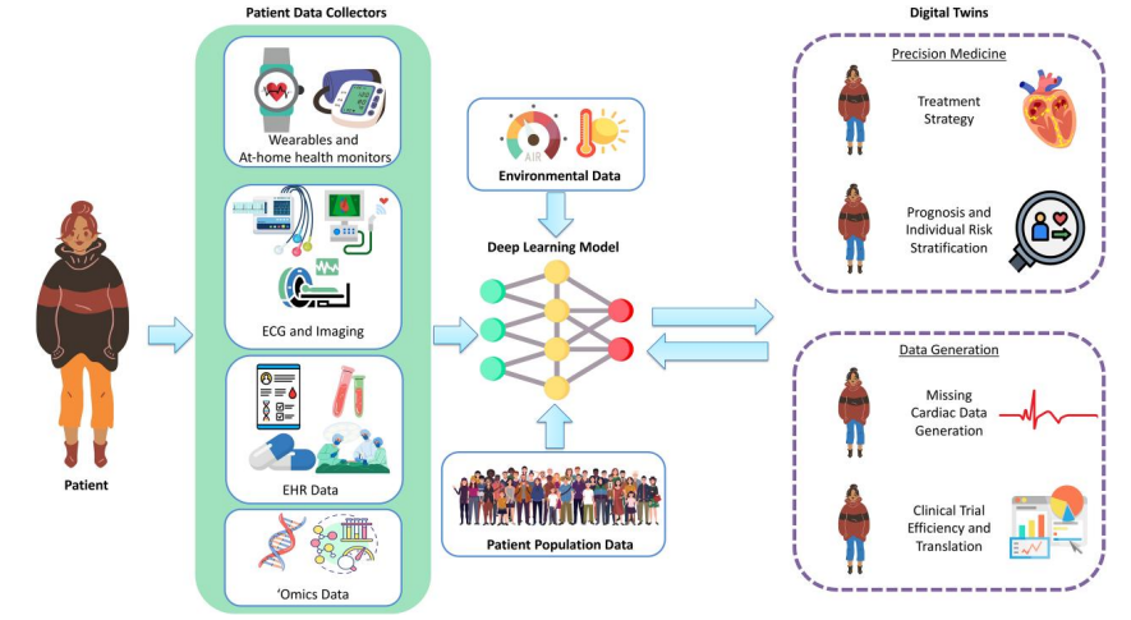
Figure 1: Potential cardiovascular clinical applications of digital twins. An overview of data available and potential digital twin applications [2]. ECG, electrocardiogram; EHR, electronic health record, ‘Omics: includes genomics, proteomics, and metabolomics data
One of the most impactful applications is in procedural planning (see examples in Figure 2). Digital twins allow clinicians to simulate interventions such as coronary revascularization or valve replacement before performing them on the patient. By testing multiple strategies in a virtual environment, physicians can optimize treatment decisions, reduce procedural risks, and improve patient outcomes. Similarly, in electrophysiology, digital twins can model cardiac electrical activity to guide ablation therapies or device implantation with greater precision.
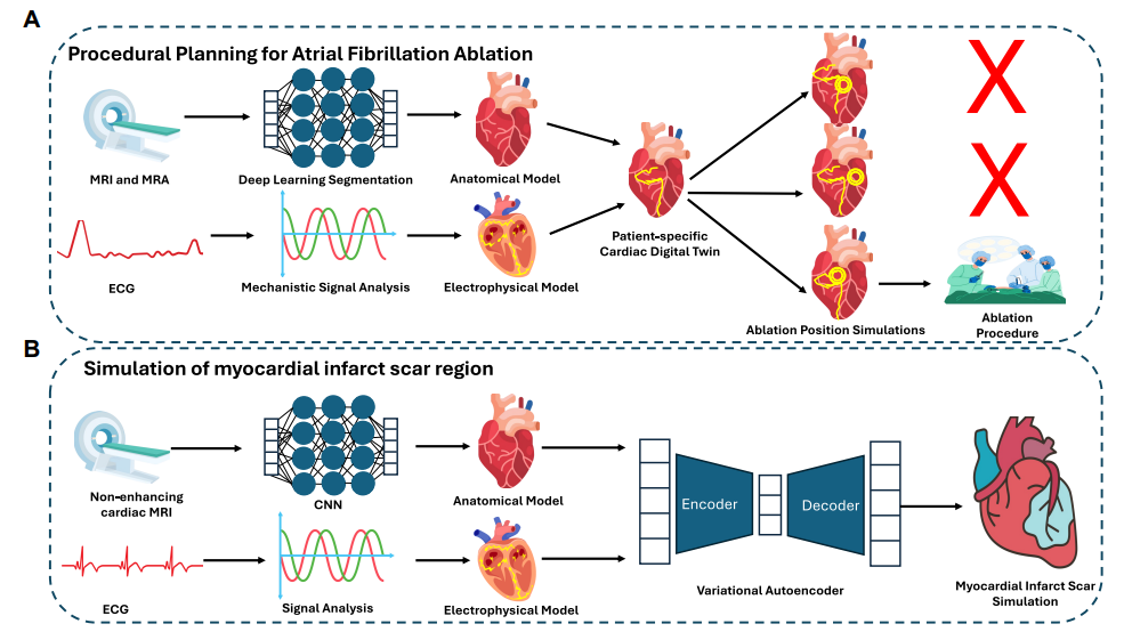
Figure 2: Selected precision medicine applications of digital twins [2]. (A) An example digital twins for procedural planning of atrial fibrillation ablation. 3D anatomical and electrophysiological models are derived from magnetic resonance imaging, magnetic resonance angiography imaging, and electrocardiograms to build a patient-specific digital twin. Different ablation locations are simulated, and the one most likely to stop atrial fibrillation is chosen. (B) An example simulation of a myocardial infarct scar. To substitute late-gadolinium enhancement magnetic resonance images, non-contrast magnetic resonance images and electrocardiograms can be combined to make an anatomical and electrophysiological cardiac digital twin. The digital twin can then be input into a variational autoencoder, which can generate simulations of 3D scarring, e.g. from myocardial infarction. ECG, electrocardiogram; CNN, convolutional neural network; MRA, magnetic resonance angiography; MRI, magnetic resonance imaging
The integration of generative artificial intelligence further expands the capabilities of digital twins. Generative models can create synthetic datasets, helping to address missing or limited clinical data and enabling more robust predictive modeling. This is particularly valuable in rare cardiovascular conditions where real-world data are scarce. Additionally, digital twins can support in silico clinical trials, reducing the cost and time required for traditional studies while enabling exploration of numerous treatment scenarios [3].
Cloud infrastructure plays a critical role in enabling these applications. The continuous collection, storage, and processing of high-dimensional patient data require scalable and secure systems. Cloud platforms facilitate real-time updates of digital twins, allowing them to dynamically reflect changes in a patient’s condition and environment.
Despite their promise, challenges remain. Ensuring data privacy, maintaining interoperability across systems, and addressing algorithmic bias are key concerns. Moreover, clinical validation through rigorous trials is essential before widespread adoption.
In conclusion, digital twins have the potential to transform cardiovascular care from a reactive to a proactive discipline. As a biomedical engineer, contributing to the development of accurate, ethical, and scalable digital twin systems will be central to advancing the future of personalized medicine.
References
[1] Amazon Web Services. What is digital twin technology? Available at: What is digital twin technology? (Accessed: 6 May 2026).
[2] Thangaraj PM, Benson SH, Oikonomou EK, Asselbergs FW, Khera R. Cardiovascular care with digital twin technology in the era of generative artificial intelligence. Eur Heart J. 2024 Dec 1;45(45):4808-4821. doi: 10.1093/eurheartj/ehae619. PMID: 39322420; PMCID: PMC11638093.
[3] Adhikari C, Das P. K, Pramanik T. Digital Twins for Drug Design: Importance, Applications and Future Perspectives. Orient J Chem 2025;41(6). Available from: https://bit.ly/47QvSin